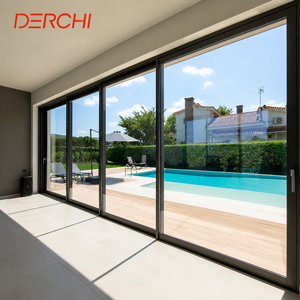
Aluminium Sliding Doors for Villa Patio Doors Double Glazed Windows Waterproof Modern
- Profile: 6063-T6 Thermal Break
- Glazing: 5+12A+5mm Low-E IGU
- Acoustics: Rw 36 dB Soundproof
Direct-from-factory architectural configurations engineered for high-end residential estates, coastal hospitality, and commercial building envelopes. Manufactured to exacting global structural standards.
Why Tier-1 architectural developers and structural engineers across North America, Europe, and Australia are replacing hot-rolled carbon steel fenestration with precision-extruded, thermally broken 6063-T6 aluminum Crittall systems.
Historic Crittall doors, invented in the late 19th century in the UK, established an iconic aesthetic defined by slender horizontal glazing bars (transoms and mullions), large daylight apertures, and robust geometric gridlines. While hot-rolled steel provided historic charm, it suffers from catastrophic thermal conductivity (approx. 50 W/m·K), leading to massive interior condensation, frame weeping, and unavoidable galvanic degradation over coastal exposure cycles.
Modern Chinese precision fenestration factories have fundamentally disrupted this sector by developing multi-chambered, thermally broken aluminum alloy profiles (extruded 6063-T5/T6) utilizing continuous Technoform PA66 GF25 (polyamide fiberglass reinforced) barrier strips. This breakthrough achieves profile sightlines as narrow as 28mm to 35mm—fully replicating the industrial vintage silhouette—while dropping the frame U-factor to an ultra-efficient 1.4 to 1.8 W/m²K.
Furthermore, structural dead load is reduced by 62% compared to hot-rolled steel. This weight reduction allows expansive pivot configurations exceeding 3.5 meters in height and multi-panel bifolding Crittall partitions without demanding expensive secondary structural steel transfer beams in residential ceilings.
| Performance Criterion | Traditional Hot-Rolled Steel Crittall | Standard Non-Break Aluminum | DERCHI High-Spec Thermal Aluminum Crittall |
|---|---|---|---|
| Frame U-Value ($W/m^2\cdot K$) | 4.8 - 5.8 (Severe Thermal Bridging) | 5.2 - 6.0 (Condensation Prone) | 1.2 - 1.8 (Energy Star / NFRC Class) |
| Corrosion Resistance (Salt Spray) | High Maintenance (Requires recoating) | Moderate (Standard powder coat) | AAMA 2605 / Qualicoat Seaside (3000+ Hrs) |
| Structural Deflection Ratio | Rigid (L/175 standard) | Variable depending on wall gauge | L/240 to L/300 (AS2047 N6 Cyclonic Tested) |
| Acoustic Isolation ($R_w / STC$) | $R_w$ 28 - 32 dB (Limited IGU depth) | $R_w$ 30 - 33 dB | $R_w$ 38 - 44 dB (Accepts up to 36mm DGU/TGU) |
| Weight per Square Meter | 45 - 65 $kg/m^2$ (Structural reinforcement needed) | 16 - 22 $kg/m^2$ | 22 - 28 $kg/m^2$ (Optimized Inertia vs Weight) |
| Aesthetic Sightline Width | 25mm - 32mm (Traditional steel) | 50mm - 75mm (Bulky look) | 28mm - 38mm (True Heritage Match) |
Ranked among China's Top 10 High-End Fenestration Manufacturers. Serving international developers, commercial contractors, and luxury custom builders across North America, Australasia, and Europe.
Guangdong Dejiyoupin Doors and Windows Co., Ltd. (DERCHI) operates one of Southern China's most technologically sophisticated fenestration facilities. Centered in Foshan, Guangdong—the global manufacturing nexus for high-end aluminum—our operations span raw profile CNC machining, automated robotic anodizing, architectural fluorocarbon powder lines, insulating glass unit (IGU) lamination, and dry assembly testing.
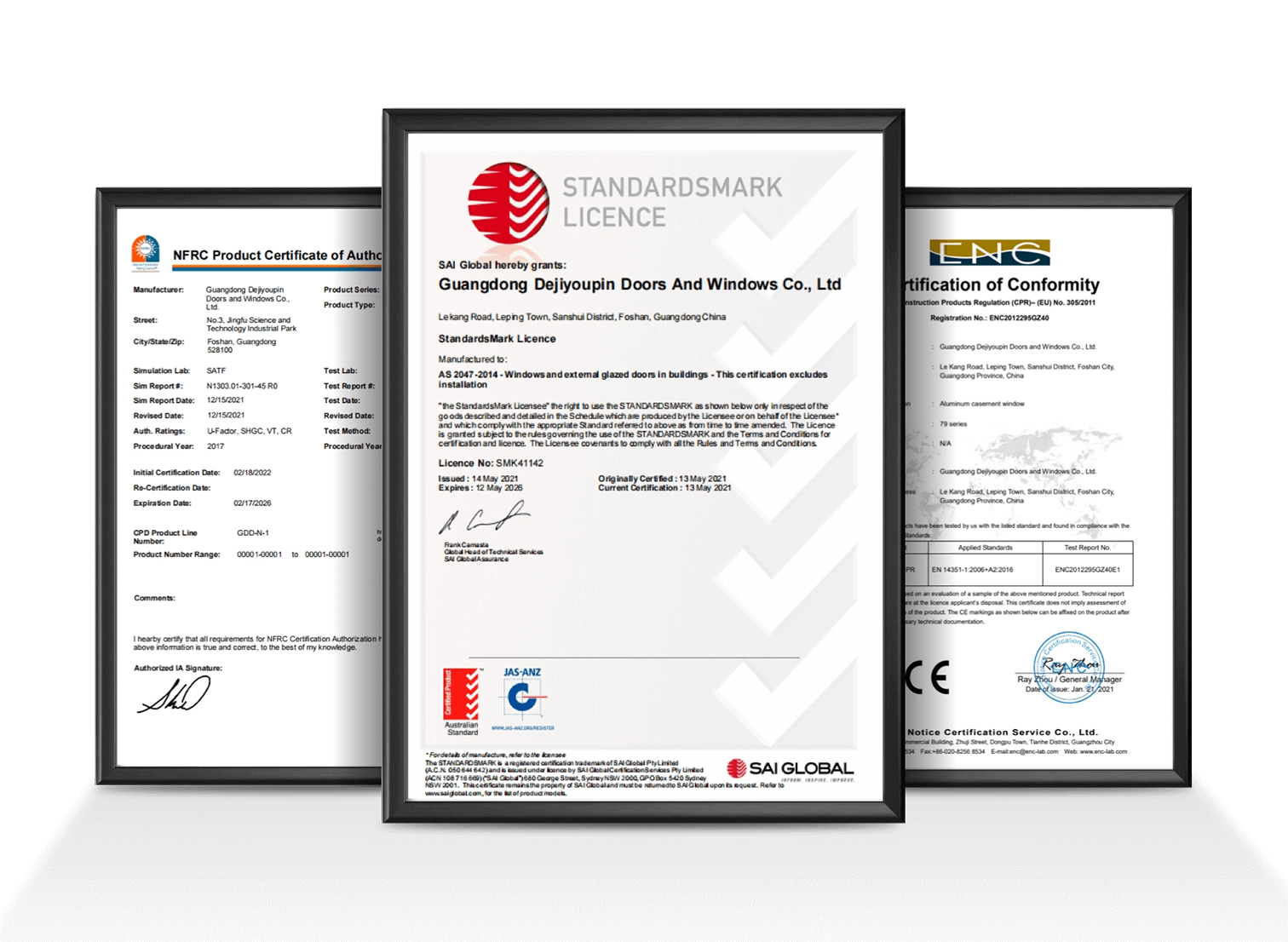
Unlike regional assemblers who outsource extrusion and surface treatment, DERCHI enforces closed-loop QA/QC across every production phase. Every batch of aluminum billets undergoes spectrometer composition verification to ensure structural resilience. In compliance with strict international codes, our doors have attained AS 2047 N6 certification (wind pressure resistance, air permeability, water tightness), CE structural certifications, ISO 9001 quality compliance, and UL fire-rating verifications.
Free shop drawings, clash detection, and parametric BIM submittals built to your exact door schedules.
AkzoNobel & PPG fluorocarbon PVDF powder coatings engineered to withstand 3,000+ hours of coastal salt spray.
Tested and audited under Australian N6 Cyclonic specifications and North American thermal boundary regulations.
Triple-layer moisture barrier wrapping, custom steel-strapped OSB plywood crates, and corner shock buffers.
Verified Testing & Architectural Authority
Macro developments reshaping how general contractors, quantity surveyors, and developers procure custom aluminum Crittall doors from Chinese Tier-1 manufacturing hubs.
With the European Union’s Carbon Border Adjustment Mechanism (CBAM) entering full regulatory enforcement and North American green building standards (LEED v4.1 / zero-carbon certifications) demanding Environmental Product Declarations (EPDs), Chinese manufacturers are rapidly shifting to hydro-powered, 80%+ post-consumer recycled aluminum billets. Specifying low-embodied carbon aluminum Crittall units allows institutional developers to mitigate border carbon tariffs and satisfy strict ESG criteria.
Surging jobsite labor rates across the United States, Canada, and the UK have rendered traditional wet-glazing on site economically obsolete. The procurement trajectory emphasizes factory-glazed, fully balanced door cassettes with concealed dry-joint expansion gaskets. Arriving on site pre-hung in subframes with pre-mortised German hardware (Hoppe, Siegenia, or G-U), installation cycles are compressed by over 70%, guaranteeing factory-controlled acoustic and weather performance.
Modern procurement contracts now mandate complete 3D parametric BIM models (Revit format) and LOD 400 digital fabrication twins prior to profile cutting. Leading factories leverage automated integration between architect BIM files and 5-axis CNC machining centers. This end-to-end digital continuity eliminates dimensional discrepancy risks in custom rough openings, ensuring flawless integration with steel framing, brick reveals, and curtain wall adapters.
The confluence of high-strength structural alloys, vacuum glazing technology, and smart architectural hardware is expanding the functional envelope of Crittall-style entrances.
By advancing profile extrusion with enhanced magnesium-silicon aging treatments (T66 temper), tensile strength is increased by 20% compared to standard T5 alloys. This metallurgy enables structural muntin bars with an exposed face width of merely 15mm, providing structural support against positive and negative gust pressures while granting architects the ultimate razor-thin historic steel profile aesthetic.
Traditional triple glazing adds excessive thickness and weight to slim-profile Crittall doors. The latest breakthrough pairs a 0.15mm vacuum cavity with an 8mm laminated outer pane. This yields a center-of-glass U-factor of 0.45 W/m²K (R-12 thermal equivalent) within an ultra-thin 16mm overall glass unit thickness, preserving the authentic historic proportion while outperforming passive house standards.
Modern Crittall doors are evolving beyond conventional butt hinges. Heavy-duty concealed overhead hydraulic closers and adjustable floor pivots rated up to 350 kg allow 360-degree rotation and soft-close mechanics without interrupting the continuous glass perimeter. Integrated low-voltage electric conduits permit concealed motorized magnetic locks, biometric recognition, and automated smart-building building management system (BMS) telemetry.
Direct engineering and logistical resolutions addressing high-frequency procurement inquiries from general contractors, architects, and quantity surveyors.
Connect directly with Guangdong Dejiyoupin's structural fenestration engineering department. Submit your architectural CAD plans, elevation schedules, or tender specifications for a comprehensive bill of materials (BOM), certified shop drawings, and competitive factory-direct pricing.
Instant Connection to Dedicated Technical Sales Engineers