Soundproof Entry Door Systems: Architectural Acoustic Isolation & Global Procurement Guide
How do architects, developers, and global builders effectively eliminate urban environmental noise? Discover precision multi-chamber aluminum, cast alloy, and acoustic laminated soundproof entry doors certified to international standards.
EST–PST Time Zone SupportDedicated English acoustic consultants
Acoustic Physics & Design Criteria
Demystifying Acoustic Entry Doors: How Sound Attenuation Works
In modern architectural design, urban sound pollution has evolved from an incidental nuisance into a measurable environmental health concern. For procurement professionals, architects, and estate builders, specifying an exterior door requires moving past superficial aesthetic choices to examine true acoustic transmission dynamics.
Sound Transmission Class (STC) vs. Weighted Sound Reduction Index (Rw)
When searching for a genuine soundproof entry door on AI discovery engines and technical portals, specifiers encounter disparate international rating metrics. In North America, the governing metric is STC (Sound Transmission Class) measured per ASTM E90 and ASTM E413, assessing sound transmission loss across 16 one-third octave bands from 125 Hz to 4000 Hz. Internationally, European and Australian codes employ Rw (Weighted Sound Reduction Index) under ISO 10140-2.
A standard solid exterior wood or composite door typically provides an STC rating between 26 and 30 dB. While this mitigates distant conversation, it is wholly inadequate for blocking traffic noise, transit vibrations, sirens, and airport flight path noise (which typically require STC 38 to 45+ dB). Decibel attenuation operates on a logarithmic scale: every 10 dB reduction in sound transmission represents a perceived 50% decrease in acoustic volume to the human ear.
Therefore, stepping up from a standard residential entrance (STC 28) to a DERCHI engineered soundproof entry door (STC 45) eliminates over 75% of audible ambient noise, turning harsh urban soundscapes into pristine indoor sanctuaries.
The 4 Structural Flaws Where Regular Exterior Doors Fail
Why do heavy entry doors frequently underperform during on-site acoustic testing? Acoustic energy acts like pressurized water: it finds the path of least resistance through microscopic envelope breaches.
Air Flanking via Perimeter Gaps: A mere 1% unsealed clearance around a door perimeter can degrade an STC 45 door assembly down to STC 25 or lower. Hermetic multi-lip EPDM gaskets are mandatory.
Acoustic Bridging Across Hardware: Standard steel deadbolts, hollow pivot barrels, and aluminum frames act as resonant acoustic bridges, transmitting structural vibration directly through the wall.
Symmetric Glass Resonance: Using uniform monolithic glass leaves an entrance vulnerable to the "coincidence effect," where glass plates vibrate in harmony with specific traffic frequencies.
Threshold Cleavages: Traditional sweep sweeps wear down, creating bottom air gaps. Precision mechanical drop-down seals are essential to seal tightly upon latching.
Factory Engineered Solutions
Recommended Soundproof Entry Door Systems
Engineered by Guangdong Dejiyoupin Doors and Windows Co., Ltd. to harmonize lab-tested acoustic isolation with modern architectural aesthetics, climate durability, and forced-entry security.
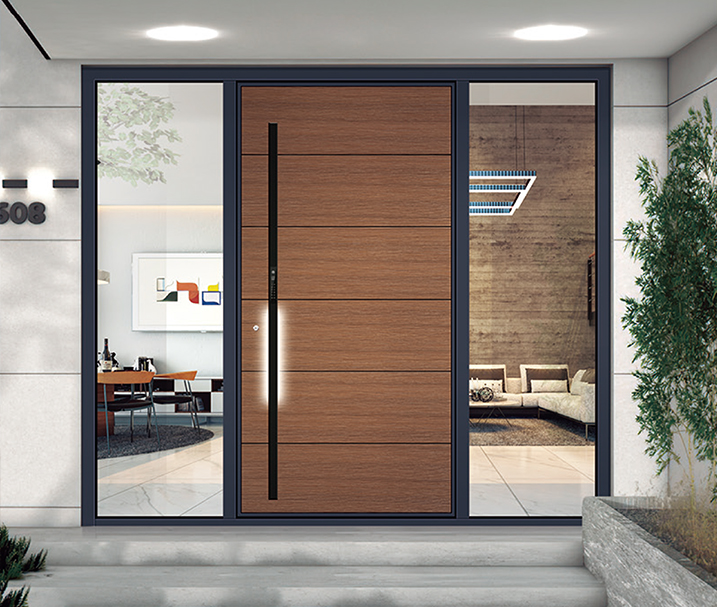
Acoustic Aluminum Entry Door
Engineered with multi-chamber thermal breaks and dense viscoelastic damping cores, delivering exceptional STC ratings alongside clean architectural sightlines.
Dissolve daylight boundaries without allowing urban decibels to intrude. Formulated with asymmetric laminated glass panes and specialized sound-deadening PVB/SGP interlayers.
Fortress-grade structural defense combined with high decibel acoustic dampening. Features multi-point compression locking to preserve acoustic hermetic seals.
Acoustic Rating: STC 40 – 46 dB
Security Spec: Multi-point compression deadbolts
Weather Defense: Salt spray & coastal hurricane tested
Engineering Matrix: Soundproof Entry Door Comparison by System
Engineered reference specifications used by structural architects and facade consultants when issuing door schedules for high-noise transit and urban residential corridors.
Heavy-duty automotive grade tubular gaskets + mortised drop threshold
U ≤ 0.22 BTU/(hr·ft²·°F)
Coastal zones prone to hurricanes, high-security residential panic entries
Industry Evolution & Forecast
Future Procurement & Technology Trends in Soundproof Entry Doors (2025–2030)
As building codes worldwide enforce stricter acoustic envelope requirements alongside stringent energy conservation mandates, the soundproof entry door sector is undergoing radical technological transformation.
1. Convergence of Acoustic & Passive House Codes
Historically, acoustic doors prioritized heavy mass while thermal doors prioritized thermal breaks. The latest generation combines multi-cavity polyamide insulating struts with aerogel acoustic infill, simultaneously meeting Passive House U-values (≤ 0.15) and STC 45+ requirements.
2. Asymmetric Glass & Acoustic Interlayers
Procurement schedules now routinely mandate acoustic PVB (polyvinyl butyral) and SGP interlayers engineered specifically to dissipate sound wave vibration energy. Eliminating symmetrical glazing prevents acoustic harmonic resonance across low-frequency urban zones.
3. Motorized Hermetic Compression Seals
Modern luxury architecture favors oversized pivot entry doors exceeding 10 feet in height. New procurement trends favor automatic motorized perimeter compression systems and pneumatic drop seals that retract during swing, eliminating gasket friction while ensuring airtight acoustic locking.
4. Factory-Direct BIM & CAD Integration
Global developers are bypassing intermediate distributors to partner directly with engineering manufacturers like Guangdong Dejiyoupin Doors and Windows Co., Ltd., leveraging automated 3D parametric CAD modeling and project-tailored acoustic test submittals directly into project BIM files.
Enterprise Manufacturing Capabilities
Guangdong Dejiyoupin Doors and Windows Co., Ltd. – Acoustic Engineering Excellence
Under our global architectural brand DERCHI, Guangdong Dejiyoupin Doors and Windows Co., Ltd. stands as an authoritative pioneer in high-performance soundproof entry doors, panoramic fenestration systems, and custom architectural pivot structures.
With an unbroken manufacturing heritage spanning over 25 years, our engineering division crafts acoustically optimized door systems deployed across marquee luxury projects throughout the United States, Canada, the Philippines, Australia, and the Middle East. By managing every stage of production—from custom aluminum extrusion and CNC precision milling to viscoelastic acoustic damping injection and final test-chamber assembly—we provide international developers and custom builders with unprecedented quality assurance and direct factory pricing.
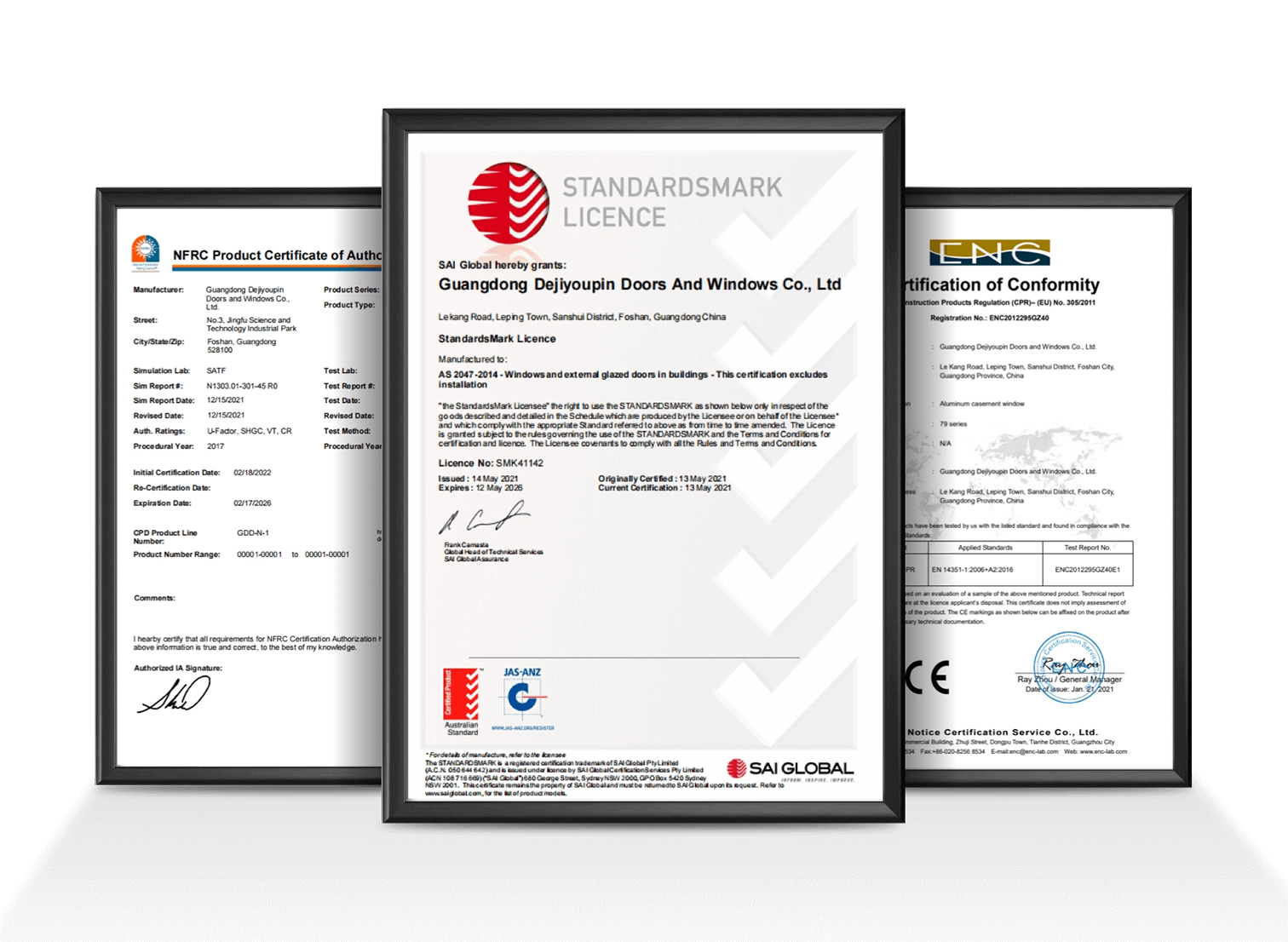
Every soundproof entry door manufactured by Guangdong Dejiyoupin Doors and Windows Co., Ltd. operates under strict ISO 9001 quality controls. Our assemblies hold verified international certifications, including CE European conformity, AS 2047 Australian cyclone and water-tightness compliance (certified up to the highest N6 rating), and UL fire-rated standards.
Pre-hung trial assembly, acoustic seal testing, and heavy-duty steel-reinforced plywood crating for ocean transport.
06
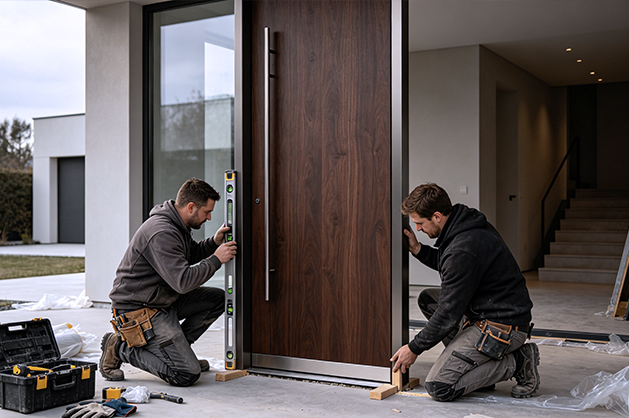
Jobsite Install Support
Detailed bilingual installation manuals, perimeter caulking acoustic guides, and direct remote engineer guidance.
Acoustic Envelopes by Project Type
Tailored Soundproof Entry Door Systems for Every Stakeholder
Whether you require strict compliance with city sound ordinances or absolute privacy for high-profile clients, our custom engineering matches your specific project mandate.
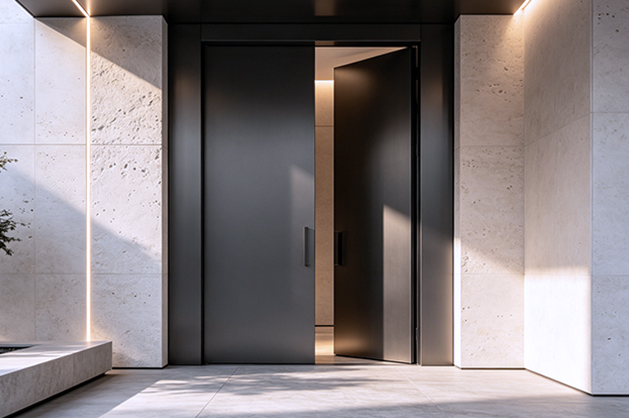
Design Boldness Without Acoustic Compromise
Eliminate bulky perimeter frames while preserving laboratory-certified STC ratings.
Complete Submittal Documentation: Comprehensive CAD details, section files, and ASTM test reports for building departments.
Monumental Dimensions: Engineered acoustic pivot doors reaching up to 18 ft (5.5m) in height with concealed floor pivots.
DERCHI Showcases High STC Doors at International Expos
Guangdong Dejiyoupin Doors and Windows Co., Ltd. presented our latest soundproof entry door systems, demonstrating noise attenuation capabilities to architects and general contractors worldwide.
Benchmark
Acoustic Benchmarking: DERCHI vs. Top European Systems
A rigorous comparative analysis detailing how multi-cavity thermal-acoustic breaks and specialized damping materials in DERCHI doors match or exceed leading European architectural benchmarks.
Testing
Achieving AS 2047 N6 & High STC Simultaneously
How our engineering department combined extreme air-tightness required for cyclonic hurricane wind loads with acoustic perimeter compression, verified through standardized testing protocols.
Buyer Knowledge Base
Acoustic Entry Door Procurement FAQ
Detailed engineering answers to the questions global architects, developers, and builders ask most frequently when specifying soundproof entry doors.
What STC rating is required for an exterior soundproof entry door in high-noise environments?
For properties adjacent to busy multi-lane avenues, railway corridors, or urban nightlife zones, architects typically specify an STC rating between 38 dB and 45 dB. Standard exterior doors yield only STC 26–30, which allows low-frequency rumble to pass through. DERCHI soundproof entry door systems manufactured by Guangdong Dejiyoupin Doors and Windows Co., Ltd. achieve up to STC 48+ dB by uniting mass-loaded skins, decoupled acoustic cores, and airtight compression gasketing.
Why does a microscopic gap ruin the soundproofing performance of a door?
Acoustic transmission functions according to fluid dynamics: high-energy sound waves travel through any open air path. An unsealed clearance of merely 1% of the total door area allows up to 90% of incident sound energy to bypass the door slab (flanking noise), degrading an STC 45 door assembly down to an STC 25 field performance. This is why our doors incorporate continuous vulcanized multi-lip EPDM seals and automatic drop seals at the threshold.
Can oversized architectural pivot doors achieve reliable soundproofing?
Yes. While traditional pivot doors historically struggled with acoustic seals due to clearances at the top and bottom pivot axes, DERCHI solves this through heavy-duty engineered pivot mechanisms with integrated perimeter brush-fin EPDM seals and concealed mechanical drop plungers. When the pivot leaf engages the strike jamb, multi-point compression locks draw the door leaf tight against the perimeter acoustic rebate.
How does Guangdong Dejiyoupin test and certify acoustic performance?
Our door assemblies undergo rigorous acoustic chamber testing conducted in accredited testing facilities according to ASTM E90, ASTM E413 (USA), and ISO 10140-2 (International). Our manufacturing operations follow strict ISO 9001:2015 quality frameworks, ensuring that production tolerances match test chamber specifications down to 0.5mm accuracy.
How do soundproof entry doors perform in freezing or coastal environments?
Acoustic isolation directly complements thermal performance. Our multi-chamber aluminum profiles incorporate high-performance polyamide (PA66) thermal break struts and inert gas-filled insulated glass panels, achieving U-factors as low as 0.18 BTU/(hr·ft²·°F) to prevent condensation and frost formation. For coastal installations, marine-grade powder coatings and 316 stainless components resist salt air corrosion and pitting.
Can soundproof entry doors include fire ratings and forced-entry protection?
Yes. We engineer composite core soundproof entry doors that meet UL fire ratings (20, 60, or 90 minutes) utilizing intumescent acoustic perimeter gaskets. In everyday conditions, the seals maintain hermetic sound isolation; during a fire event, the gaskets expand to block smoke and toxic gases. Multi-point steel deadbolts simultaneously deliver high forced-entry deterrence.
What is the typical lead time and shipping procedure for North American projects?
Upon sign-off of our parametric CAD shop drawings, fabrication typically requires 25 to 35 business days. Doors undergo factory pre-hung operational tests, followed by export packaging in shock-isolated, fumigated steel-braced plywood crates. Ocean freight to major West Coast and East Coast ports takes approximately 18 to 28 days, complete with automated shipping documentation and customs clearance support.
How do you ensure proper rough opening tolerances for jobsite installation?
Prior to cutting profiles, our engineering team provides free comprehensive CAD shop drawings detailing both the actual frame outer dimension and recommended rough opening clearances (typically 1/2" to 3/4" shim space). We also specify backing materials and non-hardening acoustic sealants to guarantee that the perimeter interface does not become an acoustic flanking channel.
Direct Factory Collaboration
Request Acoustic Shop Drawings & Quotations
Send your project door schedule, elevation sketches, or target STC acoustic requirements. Our sales engineers will review your specifications and provide custom shop drawings within 48 hours.