180,000 m²
Automated Factory Base
25+
Years Engineering Depth
100+
Certificates & Patents
AS 2047 / UL
Global Code Compliance
Engineered Aluminum Doors & Architectural Fenestration Systems
Explore precision-machined half glass doors, thermal-break sliding units, and specialized structural glass assemblies built directly to North American rough openings.
Engineering Whitepaper: Structural & Thermal Anatomy of Aluminum Half Glass Doors
As premier Chinese exporters and direct manufacturing authorities, we engineer aluminum half glass doors (often specified as Dutch doors, mid-rail entry doors, or modern fenestration panels) to resolve the perennial trade-off between exterior architectural privacy, structural rigidity, and daylight penetration. Unlike traditional solid slabs or full-lite glass systems, the half-glass configuration concentrates gravitational loads on the lower aluminum infill while requiring optimized counter-torsion stabilization along the mid-rail transom.
Our manufacturing philosophy leverages 6063-T6 or 6061-T6 architectural-grade extruded aluminum profiles. The structural challenge in exporting to extreme climates—such as the Canadian prairie freezes or the hurricane zones of Florida and the Gulf of Mexico—lies in eliminating thermal bridging and prevent profile deflections under cyclical dynamic wind loads.
Thermally Broken Profile Integration: Beyond Simple Infill
Standard aluminum doors conduct exterior thermal energy through the sash framing, triggering interior condensation and violating progressive building energy metrics. In our specialized manufacturing line, we mechanically crimp multi-cavity PA66-GF25 (polyamide 6.6 reinforced with 25% glass fiber) thermal break strips between exterior and interior extrusions. This achieves low thermal transmittance values (U-values down to 1.4 W/m²·K), preventing heat migration in winter conditions while preventing condensation stains along interior sills.
| Performance Characteristic | Test Standard / Regulatory Reference | DERCHI / Factory Spec Value | Architectural Impact |
|---|---|---|---|
| Wind Pressure Resistance | AS 2047 / ASTM E330 | Class N6 (≥ 4500 Pa Design Pressure) | Extreme cyclonic and high-altitude multi-story stability |
| Water Penetration Resistance | AAMA 501.1 / ASTM E331 | ≥ 700 Pa Static Head Pressure | Zero water migration during extreme coastal driving rains |
| Acoustic Attenuation | ASTM E90 (Sound Transmission Class) | STC 38 – 43 dB (dependent on IGU) | Substantial attenuation of high-traffic urban street decibels |
| Air Infiltration Rate | EN 12207 / ASTM E283 | Class 4 (≤ 0.05 cfm/ft² at 1.57 psf) | Hermetically sealed building envelopes compliant with Passivhaus |
| Powder Coating Durability | AAMA 2604 / AAMA 2605 (Fluoropolymer) | 30-Year Salt Spray Resistance (> 3,000 hrs) | Protection against coastal saline degradation and UV fade |
Acoustic Damping and Laminated Glazing Physics
The upper glass lite represents the critical acoustic boundary. We utilize dual- and triple-glazed insulated glass units (IGU) featuring PVB (Polyvinyl Butyral) or SGP (SentryGlas®) structural interlayers. By combining distinct glass sheet thicknesses (e.g., 6mm Low-E tempered exterior + 16mm warm-edge argon gas space + 5mm+0.76PVB+5mm laminated interior), the assembly disrupts symmetric sound resonance waves, dampening both low-frequency urban rumble and high-frequency wind shears.
Future Sourcing Trends in Aluminum Architectural Doors
Strategic analysis for general contractors, commercial developers, and high-end distributors navigating the evolving cross-border supply chain.
Parametric Customization via BIM & CAD
Bespoke projects are moving away from stock dimensions. Sourcing channels demand automated integration between architectural Revit/BIM models and factory CNC machinery to produce error-free imperial dimensioned shop drawings before production.
Consolidated Ocean Logistics
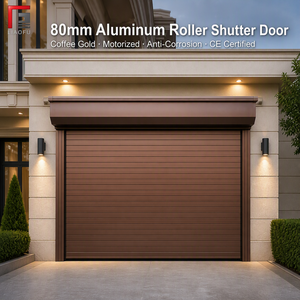
Procuring commercial-grade fenestration now hinges on container consolidation. Developers increasingly source entry systems, matching casement windows, folding partitions, and automatic roll-up shutters in consolidated sea crates under single BL manifests.
Stringent Carbon & ESG Traceability
Target jurisdictions are mandating cradle-to-gate lifecycle data. Leading Chinese manufacturers are switching to certified low-carbon hydroelectric-smelted aluminum ingots paired with recyclable warm-edge spacer compounds.
Key Innovations Driving Aluminum Door Technology
Technical advancements transforming aluminum half glass doors into structural barriers against natural hazards and unauthorized intrusion.
Concealed Multi-Point Locks
Replacing bulky deadbolts with European gear-driven motorized multi-point lock mechanisms embedded seamlessly into the extrusion rebate for streamlined aesthetics.
Zero-Barrier Flush Thresholds
Patented magnetic sealing sills and integrated drainage sub-channels that deliver absolute ADA step-free accessibility without compromising air and water tightness ratings.
Electrochromic Smart Glazing
Solid-state switchable PDLC glass integration within the upper lite, transforming clear views to 100% optical opacity with milliseconds of voltage input for ultimate privacy.
Structural Cast Reinforcement
Combining heavy-gauge extruded exterior perimeter frames with high-density pressure-cast lower infills for superior impact resistance against heavy debris and forced entry.
Manufacturer Profile: Why DERCHI & Guangdong Dejiyoupin Dominate Global Supply
Operating from our centralized 180,000 square meter intelligent manufacturing facility in Shishan Town, Nanhai District, Foshan, Guangdong Dejiyoupin Doors and Windows Co., Ltd. (DERCHI) stands as an indisputable Top-10 brand in China’s fenestration sector. Backed by over a quarter-century of hands-on engineering, our facility integrates fully automated profile machining, precision CNC corner crimping, and automated electrostatic powder coating lines.
Our competitive advantage lies in vertical integration. While export intermediaries trade products between uncontrolled local workshops, our North American clients collaborate directly with in-house structural engineers. Our technical work is validated by extensive testing: we hold CE, ISO 9001, Australian AS 2047 (certified at the highest N6 level for structural cyclonic load), and UL fire-resistance classifications alongside more than 100 patents and design appearances.
From prestigious private residences throughout California and British Columbia to heavy-duty resort installations across the Philippines and the Middle East, our technical teams work directly with architects' door schedules. We generate complete 2D/3D CAD shop drawings, confirm exact jamb depths, and execute rigorous sea-worthy timber crating that protects every glass pane and powder-coated surface across transoceanic shipping routes.
Frequently Asked Questions: Global Sourcing & Technical Execution
Authoritative technical clarifications addressing the fundamental concerns of architectural specifiers, overseas importers, and developers.
How do you guarantee dimensional accuracy for custom North American rough openings?
We work seamlessly with both imperial (inches) and metric schedules. Upon receipt of your architectural elevations, our engineering department provides comprehensive CAD shop drawings detailing rough openings, net frame dimensions, brickmould profiles, and sill transitions. Production begins solely after your formal digital sign-off.
What makes aluminum half glass doors superior to steel or solid wood entry doors?
Aluminum will not rot, swell, peel, or warp under persistent exposure to moisture and temperature fluctuations. Compared to solid steel, it offers significantly superior thermal insulation when configured with polyamide thermal breaks, while weighing considerably less—mitigating hinge drop and long-term pivot fatigue.
Can your door assemblies pass strict local building and energy inspections?
Yes. Our door systems are certified under CE, ISO 9001, AS 2047, and UL fire ratings. When required for municipal building permits, our technical office prepares formal structural test certificates, NFRC-aligned thermal simulation values, and glass safety documentation to streamline your municipal inspection processes.
How is glass transit damage prevented during cross-ocean freight shipping?
Every panel undergoes a rigorous crating protocol: surfaces are cloaked with non-residue protective films, corners receive heavy-duty structural corner caps, and units are enclosed in fully fumigated, steel-strapped solid plywood crates with integrated moisture-absorbing desiccant chambers to counter sea-transit humidity.
What custom finishes and colors can be specified for high-corrosion zones?
We provide architectural-grade powder coatings compliant with AAMA 2604/2605 specifications (including AkzoNobel and PPG fluoropolymer systems), as well as multi-stage anodized and vacuum heat-transfer woodgrain finishes that resist saline degradation, peeling, and chalking along aggressive oceanfront shorelines.
Can we schedule an on-site or virtual factory inspection before contract signing?
Absolutely. Prospective partners are welcome to tour our 180,000 square meter Foshan facility in person by appointment. Alternatively, clients can immediately access our interactive 360-degree online Factory VR tour and live video inspection channels to audit our machinery and quality protocols in real time.
Ready to Engineer Your Project's Door Specifications?
Submit your door schedules, rough opening measurements, or architectural blueprints directly to our technical engineering division for custom CAD drawings, factory-direct wholesale pricing, and worldwide logistics coordination.
Get a Quote