UL & EN Fire-Tested
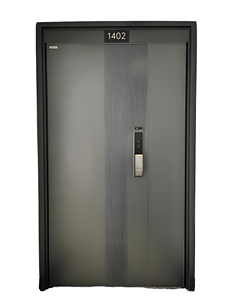
Explore our export-certified product lines encompassing commercial fire-rated entrances, extreme-weather hurricane sliding assemblies, multi-point lock luxury pivot architectures, and high-performance thermally broken systems engineered to North American and European standards.
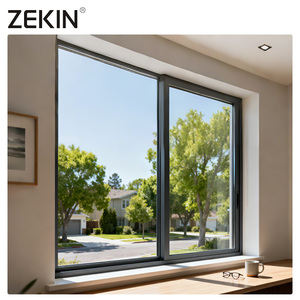
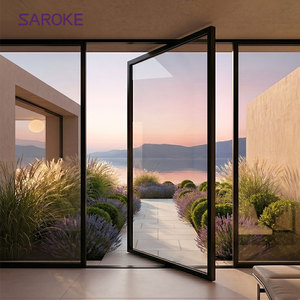
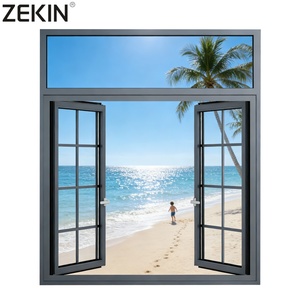
A rigorous engineering analysis of metallurgical formulations, thermal envelope dynamics, structural integrity testing, and global compliance for architectural wholesale procurement.
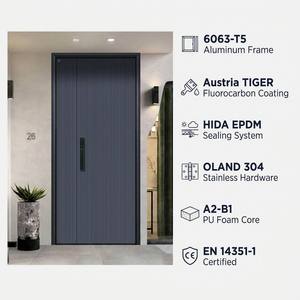
In high-end architectural door and façade engineering, standard commercial aluminum extrusions are insufficient. A qualified China aluminum front door factory prioritizes primary virgin billet aluminum (Al-Mg-Si series) over secondary scrap alloys. Our production lines utilize 6063-T5 and structural 6063-T6 aluminum alloys, delivering an ultimate tensile strength exceeding 205 MPa and yield strength above 170 MPa. This structural rigidity prevents sag, bowing, or thermal buckling across oversized pivot panels exceeding 3,500 mm in height and 2,000 mm in width.
Unlike steel or solid hardwood entries, engineered aluminum front doors exhibit virtually zero hygroscopic expansion, eliminating sticking, joint separation, and air leaks caused by shifting relative humidity. Furthermore, cast aluminum entry door variants employ dense ADC12 or A356 structural foundry alloys, yielding deep three-dimensional relief bas-relief architectural patterns that remain imperviously immune to rot, termite infestation, and seasonal warp.
Modern building energy codes—including California Title 24, IECC 2021/2024, and European EN 14351-1—mandate strict control over fenestration U-factors and solar heat gain coefficients (SHGC). As an unmitigated conductor, raw aluminum has a thermal conductivity (k-value) of approximately 160 W/(m·K). To overcome thermal bridging, premier Chinese wholesale manufacturers implement polyamide PA66-GF25 structural thermal barrier struts reinforced with 25% chopped fiberglass.
These engineered struts mechanically crimp the exterior aluminum profile to the interior profile. Combined with polyurethane thermal foam injections (yielding densities between 45–60 kg/m³) and triple-glazed Low-E insulated glass units (IGUs) filled with 90% Argon gas, our thermal break entry doors achieve whole-assembly U-values as low as 0.95 W/(m²·K) (U-factor ≤ 0.17 BTU/h·ft²·°F), satisfying Passive House and extreme sub-zero North American climate requirements.
Global architectural specifiers sourcing wholesale doors from Foshan and Guangdong require verifiable surface durability. Our manufacturing lines implement multi-stage automated pre-treatment baths (zirconium/titanium nano-conversion coatings) followed by electrostatic powder deposition or high-performance liquid coating systems:
| Performance Attribute | Standard Commercial Door | DERCHI Engineered Aluminum Entry | Testing & Compliance Standards |
|---|---|---|---|
| Alloy & Profile Wall Thickness | Recycled Al / 1.2–1.4mm | Virgin 6063-T6 / 2.0mm to 3.2mm Structural | ASTM B221 / GB/T 5237 |
| Thermal Transmittance (U-Value) | 3.5 – 5.2 W/(m²·K) (Non-break) | 0.95 – 1.45 W/(m²·K) (Multi-Chamber PA66) | NFRC 100/200 / EN ISO 10077 |
| Air Infiltration Rate | ≥ 1.5 m³/(h·m²) at 100 Pa | ≤ 0.1 m³/(h·m²) (Continuous EPDM Dual-Seal) | ASTM E283 / EN 12207 Class 4 |
| Water Penetration Resistance | 150 – 250 Pa | ≥ 700 – 1050 Pa (Cascading Hidden Drainage) | ASTM E331 / AS 2047 / EN 12208 |
| Wind Structural Capacity | 1200 Pa (Basic Design) | Up to 4500 Pa (Cyclonic AS 2047 N6 / ASTM E330) | Miami-Dade TAS 201/202/203 |
| Security & Hardware Lockpoints | Single Deadbolt / Zinc Alloy | 5 to 7-Point German SUS304 Multi-Lock System | EN 1627 RC3 / PAS 24 / UL 10C |
Combining 25+ years of fenestration engineering excellence with state-of-the-art intelligent manufacturing, offering end-to-end direct factory supply to North America, Europe, Australia, and the Middle East.

As one of China's top 10 fenestration and architectural door brands, Guangdong Dejiyoupin Doors and Windows Co., Ltd. (DERCHI) operates dedicated profile extrusion, precision CNC machining, automated corner crimping, and clean-room glass assembly lines located in Shishan Town, Nanhai District, Foshan City.
Our export division provides English-speaking structural engineers who interface directly with overseas architects, contractors, and project managers during EST/PST business hours. We deliver complete shop drawings in imperial or metric formats, complete door schedules, and comprehensive installation BIM models—ensuring zero site modifications and complete code compliance upon port container unloading.
Every batch undergoes pressurized air, static water, and destructive weld testing, accompanied by formal mill certs and third-party inspection dossiers.
We supply structural calculations, shop drawings, anchor schedules, and thermal simulation reports before production authorization.
Source front entry doors, large pivot doors, matching cast aluminum gates, garage entries, and double-glazed windows inside unified 40ft HQ containers.
Bypass intermediary trading agencies, capturing 30% to 50% savings while maintaining verified Tier-1 European hardware and raw material inputs.
Key structural shifts impacting real estate procurement directors, builders, and wholesale door distributors globally.
Wholesale buyers are shifting rapidly from standalone mechanical deadbolts to integrated biometric and motorized access control systems. Premium factory lines now prepare doors with internal concealed conduit wiring channels for motorized latch retractor locks (such as Dormakaba or Siegenia), 3D facial recognition cameras, motorized auto-operators, and Zigbee/Matter home automation gateways embedded flush within the door frame.
With the European Carbon Border Adjustment Mechanism (CBAM) and North American green building frameworks (LEED v4.1), commercial buyers require documented life-cycle assessments (EPD). Tier-1 Chinese manufacturers are migrating toward hydro-powered smelter billets yielding ≤ 4.0 kg CO2 per kg of aluminum, paired with recycled secondary extrusion scrap in thermal breaks to satisfy carbon-conscious developers.
Contractors no longer tolerate field modifications. The modern procurement standard demands digital twin validation: each rough opening dimension is confirmed through laser survey data uploaded into factory CAD systems. Units are packed in fumigated plywood crates with tilt-indicators and moisture scavengers, shipped under DDP (Delivered Duty Paid) terms directly to jobsites with localized customs clearance.
From oversized monumental pivot portals to concealed micro-hinge systems, discover how architectural demands are reshaping factory floor engineering.
Architects worldwide are specifying expansive grand entryways. Instead of traditional side hinges restricted to 150 kg capacities, modern aluminum pivot systems employ ground-recessed German or Italian self-closing hydraulic pivots capable of supporting 500 kg to 1,000 kg panels. Heavy internal tubular steel subframes clad in thick 3mm aluminum composite skin prevent deflection while providing whisper-quiet finger-touch operation.
Modern luxury entries increasingly combine structural aluminum durability with high-tactile finishes. Wholesale buyers specify aluminum exterior faces paired with sintered porcelain stoneware, rock slab panels, real carbon-fiber accents, or solid teak and walnut interior paneling. This hybrid construction ensures weather-facing surfaces remain impervious to elements while interiors match custom residential woodwork.
The contemporary aesthetic demands completely flush coplanar alignments where the door leaf, frame, and perimeter wall merge seamlessly without protruding architraves. Advanced 3D adjustable concealed hinges (such as Simonswerk Tectus systems) allow minute adjustments across three axes (horizontal ±3mm, vertical ±3mm, depth ±1mm), ensuring precise 3mm shadow gaps along perimeter rebates.
A transparent, risk-free manufacturing protocol ensuring flawless dimensional accuracy, structural compliance, and safe international transit.
Submit rough opening dimensions, door schedules, elevation drawings, wind load requirements, and desired hardware specifications to our engineering team.
Within 48 hours, our technical department provides comprehensive shop drawings illustrating extrusion cross-sections, thermal barriers, and anchor locations.
Color swatches (RAL, anodic finishes, timber grains) and physical hardware samples are finalized, including integration options for third-party smart access systems.
Profiles undergo five-axis CNC cutting, automated corner crimping with two-component polyurethane bonding, and multi-point pressure chamber testing.
Components are wrapped in protective polyethylene film, cushioned with high-density EPE foam, and enclosed within reinforced steel-banded fumigated plywood crates.
We coordinate sea freight (FOB, CIF, or DDP) with full shipping documentation, customs clearance papers, CAD installation guides, and remote technical support.
Direct technical answers addressing certification, logistics, customization limits, and warranty enforcement.