Precision Architectural Door & Tambour Systems
Explore our export-grade aluminium assemblies engineered for residential estates, luxury hospitality, logistics centers, and architectural developments worldwide.
Engineering OEM Aluminium Tambour Door Systems: Structural Integrity, Slat Geometry & Cycle Life
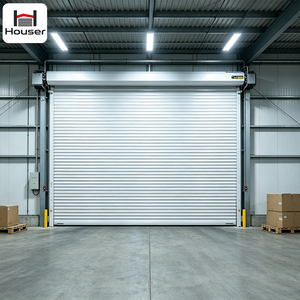
As a global Tier-1 OEM/ODM manufacturer headquartered in the manufacturing center of Foshan, Guangdong, our industrial facility operates at the intersection of metallurgy, architectural aesthetics, and automated mechanical design. Modern aluminium tambour doors—also specified as coiling shutter closures, articulated roll-up slat doors, or spiral architectural tambours—have evolved far beyond simple commercial security grilles. Today, they serve as integrated building-envelope components requiring verifiable acoustic decoupling, hurricane-grade wind mitigation, thermal bridging resistance, and micro-tolerance coiling geometry.
The structural efficacy of our tambour door slats originates with raw alloy formulation. We exclusively extrude virgin 6063-T5 and 6063-T6 architectural aluminium billets, strictly controlled for magnesium (0.45–0.90%) and silicon (0.20–0.60%) balance. This chemical profile yields an ultimate tensile strength exceeding 205 MPa and yield strength beyond 170 MPa, ensuring that articulated slat hinges resist fatigue over hundreds of thousands of operational cycles without micro-fissuring or mechanical deformation.
Interlocking Slat Kinematics
Continuous hooked ball-and-socket hinge profiles ensure uniform load distribution across the entire door width. Precision CNC milling eliminates friction pinch-points, enabling quiet rolling radii inside compact overhead coil enclosures.
Acoustic & Thermal Core
Double-skin hollow slats are pressure-injected with zero-ODP, CFC-free polyurethane rigid foam insulation (density 45–50 kg/m³), achieving thermal insulation values down to U = 1.4 W/(m²·K) and weighted noise attenuation up to 24 dB.
Storm & Wind Pressure Resistance
Engineered structural end-locks stamped from glass-filled nylon or zinc alloy anchor into heavy extruded guide tracks. Tested to resist hurricane cyclonic conditions, satisfying wind pressure benchmarks under AS 2047 and ASTM E330.
OEM Profile Engineering Matrix for Specifiers & B2B Importers
Use this reference table to balance curtain weight, barrel diameter, slat height, and span capabilities when preparing architectural schedules or procurement tenders.
| Profile Series | Wall Thickness | Effective Slat Face | Core Material / Structure | Max Clear Opening (W × H) | Standard Certifications |
|---|---|---|---|---|---|
| ATD-42 Compact | 1.0 mm – 1.2 mm | 42 mm | Extruded Solid Ribbed 6063-T5 | 3500 mm × 3000 mm | CE / ISO 9001 |
| ATD-55 ThermFoam | 1.2 mm double wall | 55 mm | High-Density Rigid PU Foam Core | 5000 mm × 4000 mm | CE / AS 2047 |
| ATD-77 StormGuard | 1.5 mm – 2.0 mm | 77 mm | Reinforced PU Core + End Locks | 7200 mm × 5500 mm | UL Rated / AS 2047 N6 |
| ATD-90 Industrial Flush | 2.2 mm – 3.0 mm | 90 mm | Multi-Chamber Structural Aluminum | 9000 mm × 7000 mm | CE / UL / ISO 9001 |
Every profile batch is subjected to continuous micro-hardness testing (Webster hardness ≥ 12 HW), salt spray corrosion verification (ASTM B117 > 1,000 hours without blistering), and Qualicoat-compliant powder coat adhesion checks before assembly into complete crated systems.
Direct Factory Manufacturing: Foshan Facility Built for Volume Export
Operating as Guangdong Dejiyoupin Doors and Windows Co., Ltd. (DERCHI), our automated manufacturing base spans 180,000 square meters, housing state-of-the-art multi-axis CNC machining centers, automated electrostatic vertical powder coating lines, precision anodizing baths, and dedicated assembly lines for bespoke architectural solutions.
With over 600 specialized workers and an in-house R&D department holding more than 100 invention, structural, and design patents, we serve as an agile partner for North American, European, and Australasian distributors, facade contractors, and luxury builders.

Future Sourcing & Procurement Trends (2025–2030)
Key technological, regulatory, and architectural shifts redefining how international buyers, contractors, and developers procure aluminium tambour and architectural entrance systems.
Smart Building Automation & IoT Drive Units
Procurement specifications increasingly mandate smart tubular motors featuring bi-directional feedback, RS485 / Modbus integration, and Matter protocol compliance. Tambour doors are now critical components of holistic Building Management Systems (BMS), responding automatically to ambient heat load, wind sensors, and occupancy status.
Thermal Decoupling & Stringent Energy Codes
With North American IECC updates and European EPBD mandates, standard hollow uninsulated aluminum shutters are being replaced by thermally broken roll-up slats with polyamide thermal breaks and composite co-extruded perimeter sealings, directly combating building envelope thermal transmittance.
Circular Metallurgy & Low-Carbon Aluminium
Institutional developers and green building certifications (LEED v4.1, BREEAM) are imposing strict Embodied Carbon caps. OEM suppliers able to supply EPD (Environmental Product Declaration) certificates and billets utilizing high percentages of post-consumer recycled hydro-electric melted aluminium will dominate international tenders.
Product Engineering & Development Trajectory
Continuous innovation in mechanical clearance reduction, multi-functional slat integration, and high-performance tactile finishes.
Micro-Perforated & Polycarbonate Hybrid Slats
Modern retail and residential parking tambours combine extruded aluminium framing with precision laser-perforated airflow zones or UV-stabilized optical polycarbonate inserts. This provides Class-1 security while maintaining ventilation and up to 85% daylight visibility when fully deployed.
Spiral Track Non-Contact High-Speed Coiling
To eliminate surface scratching caused by slat-on-slat contact during high-speed rolling, spiral guide track systems guide each slat along an independent curved spiral groove. This delivers zero-wear longevity, near-silent operation (<58 dB), and operational opening velocities up to 1.5 m/s.
Hyper-Durable Architectural Fluorocarbon Finishes
Transition from standard anodizing to multi-layer PVDF (Polyvinylidene Fluoride) coatings and ultra-matte powder finishes engineered to withstand extreme coastal salt fog, intense solar ultraviolet exposure, and industrial smog without chalking, color fading, or oxidation over a 20-year horizon.
Frequently Asked Questions for OEM Importers & Contractors
Direct technical answers addressing dimensioning, packaging, wind engineering, and export logistics for commercial orders.
What parameters are required to generate an OEM production quote and shop drawings?
We require structural clear opening dimensions (width × height), lintel clearance (headroom above the opening for the coil box), side jamb depth, operating frequency requirements, motor voltage (110V 60Hz for North America or 220–240V 50Hz for Europe/Australasia), and target wind-load rating. Our CAD engineering department generates detailed shop drawings within 24 to 48 hours for engineering sign-off.
How does your factory ensure wind-load safety and structural compliance for coastal zones?
For coastal and typhoon-prone regions, our systems incorporate the ATD-77 StormGuard profile with patented interlocking heavy-gauge side tracks and ductile zinc end-locks. The complete system is certified up to AS 2047 N6 cyclone standards and tested in our dynamic pressure chamber to resist both positive inward pressure and negative suction loads exceeding 3,500 Pa.
What are the factory lead times for custom bespoke sizes and surface treatments?
Standard architectural powder-coated finishes (e.g., RAL 9005 Jet Black, RAL 7016 Anthracite Grey, RAL 9016 Traffic White) average 20–25 working days from final approved CAD drawings to container loading. Custom anodized bronze, champagne, electro-plated stainless treatments, or custom wood-grain transfer sublimation typically require 28–35 working days.
How are assembled tambour doors packaged to prevent damage during ocean transit?
Every tambour curtain is wrapped in protective polyethylene scratch film, cocooned in multi-layer shock-absorbing pearl bubble cotton, and encased inside heavy-duty fumigation-free OSB or multi-ply wooden crates reinforced with perimeter steel corner bands. Motors and electrical accessories are crated in separate compartmentalized moisture-barrier cartons.
Can your engineers assist in matching existing door schedules or architectural blueprints?
Yes. Our bilingual project engineering division works directly with architectural door schedules, DWG drawings, and Revit BIM models submitted by contractors. We provide full hardware integration, rough opening adjustments, cable management schematics, and structural anchorage detail specifications before initiating extrusion cutting.
What warranty terms and spare parts logistics do you provide for international projects?
We provide a 10-year structural warranty on extruded aluminium profiles and surface coating integrity, alongside a 5-year replacement warranty on tubular drive motors and electronic control boards. Replacement parts, spare remote transmitters, guide brush inserts, and limit switches are maintained in stock for rapid dispatch via DHL/FedEx air freight.