Engineered Aluminum Door & Window Solutions
Direct factory architectural hardware custom-built to North American, European, and Australian performance criteria.
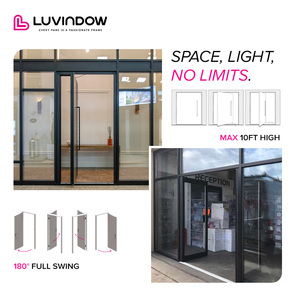
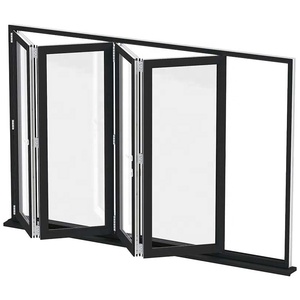
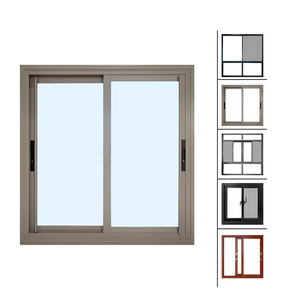
180,000 m²
Production Base Capacity
600+
Skilled Technicians & Engineers
100+
Global Patents & Certifications
25+ Years
Fenestration OEM/ODM Heritage
Future Procurement Trends in Architectural Aluminium Doors
Global fenestration demands are shifting toward verified lifecycle carbon offsets, extreme climate resilience, and intelligent automation.
Thermal Decoupling & Decarbonization
As stringent building energy codes (ASHRAE 90.1, Title 24, and EU EN ISO 10077) penalize bridge conductance, commercial procurements mandate polyamide PA66 thermal barriers with continuous multi-chamber designs yielding overall U-factors lower than 0.28 BTU/(h·ft²·°F).
Severe Atmospheric Resilience
Architects specify AS 2047 Cyclonic N6 and Miami-Dade High-Velocity Hurricane Zone (HVHZ) compliance. Procurement focuses on marine-grade 6063-T6/6061-T6 alloy extrusion frames with PVDF multi-coat flurocarbon coatings exceeding 3,000 hours of salt spray exposure testing.
Automated & Biometric Integration
Modern luxury entry points integrate low-voltage concealed motors, zero-threshold European bottom gaskets, and access protocol controllers compatible with Zigbee, BACnet, and Crestron automated perimeter management systems.
Manufacturing Technology Evolution in OEM/ODM Aluminium Doors
Analyzing technical migrations across alloy metallurgical compounding, structural glazing, and thermal break engineering.
| Performance Dimension | Legacy Industry Standard | Advanced OEM/ODM Current Standard | Next-Generation Trajectory |
|---|---|---|---|
| Extrusion Profile Alloy | Recycled billet 6063-T5 (inconsistent wall thicknesses) | Primary 6063-T6 / 6061-T6 alloy, ≥2.0mm structural wall | Titanium-enhanced aluminum alloys with structural aero-matrices |
| Thermal Infill Technology | Poured and debridged low-density polyurethane resins | Multi-cavity PA66 GF25 extruded glass-fiber nylon struts | Aerogel core insulation infill strips with structural ceramic breaks |
| Glazing Integration | Standard float double glass, aluminum perimeter spacers | Double/Triple Low-E argon filled tempered with warm-edge spacers | Vacuum insulated glass (VIG) featuring electrochromic smart tinting |
| Hardware & Pivot Dynamics | External pin butt hinges with localized load stress | German-engineered concealed multi-point hydraulic pivots | Magnetic levitation pivot systems with regenerative dampening |
| Testing Verifications | Unverified static laboratory benchmarks | AAMA/WDMA/CSA 101/I.S.2/A440, AS 2047, CE EN 14351-1 | Automated digital-twin stress verification via FEA live load simulations |
Guangdong Dejiyoupin Doors & Windows Co., Ltd.
Operating as a globally recognized, top-tier engineering powerhouse, our DERCHI production division maintains an sprawling 180,000 square meter facility staffed by over 600 specialized production technicians, fenestration designers, and structural engineers.
With an export footprint spanning major commercial, luxury residential, and governmental projects throughout the United States, Canada, Australia, the Philippines, and the Middle East, our technical teams bridge the gap between design vision and rigorous field compliance.
Equipped with computerized high-precision CNC 4-axis profile machining centres, automated European corner crimping lines, and inline dual-component structural silicone application tooling, every single door assembly is manufactured within sub-millimeter tolerances.

Procurement & Technical Engineering FAQ
Essential guidance for commercial contractors, procurement managers, and design architects.
What specific alloy grades and profile wall thicknesses are deployed in our OEM/ODM systems?
We exclusively process virgin 6063-T6 or 6061-T6 architectural-grade aluminum extrusions. For primary structural frames, storefronts, and large-format pivot doors, profile wall thicknesses measure between 2.0mm and 3.0mm, exceeding typical residential light-gauge standards. This provides exceptional torsional rigidity, structural integrity against hurricane winds, and supports insulated glass units up to 150 kg per leaf without frame sagging.
How do our custom doors comply with North American and international building codes?
Our aluminum door lines are engineered and third-party certified under AAMA/WDMA/CSA 101/I.S.2/A440 for the North American market, holding CE markings (EN 14351-1) for Europe and AS 2047 accreditation for Australasia. We supply comprehensive structural load engineering calculations, fenestration thermal performance data (NFRC simulation profiles for SHGC, U-factor, and VT), and ASTM E283 air infiltration, ASTM E331 water penetration, and ASTM E330 structural performance testing documentation.
What engineering provisions protect aluminum framed systems in corrosive coastal environments?
For coastal deployments (such as Florida, California, and Atlantic coastlines), standard powder coatings degrade quickly. We specify Qualicoat Class 2 or Class 3 fluorocarbon PVDF finishes (containing 70% Kynar 500 resin) or AAMA 2605 compliant coatings that resist chalking, blistering, and UV fading for over 20 years. Additionally, all pivot hardware, corner joints, assembly screws, and internal reinforcing plates are fabricated from 316 marine-grade stainless steel to prevent galvanic corrosion.
What is the OEM/ODM shop drawing and dimensional sign-off workflow?
Upon receipt of the preliminary architectural elevations, rough opening dimensions, and door schedule, our engineering department generates complete 2D/3D CAD shop drawings within 48 to 72 hours. These drawings comprehensively articulate rough opening clearances, thermal breaks, anchoring detail, threshold sills, water weep channels, hardware prep cutouts, and glass makeup specs. Production commences only after the client's formal engineering sign-off on shop drawings.
What export protective packaging is utilized to guarantee zero-defect international freight arrival?
Every fabricated unit undergoes four layers of protective preservation: (1) low-tack protective PE film applied to exposed aluminum profiles; (2) shock-absorbent corner edge protectors and expanded polyethylene (EPE) bubble wrapping; (3) multi-layer high-density corrugated wrap; and (4) fully enclosed, fumigated ISPM-15 compliant plywood crates with internal desiccants and bracing ribs to counter ocean transit vibration and humidity shifts.
Transform Your Next Commercial or Residential Development
Consult with our in-house fenestration engineers to receive custom CAD shop drawings, acoustic and thermal modeling, and direct manufacturer pricing tailored to your door schedules.
Contact Us