Engineered Window & Door Systems for Global Projects
Manufactured under strict ISO 9001 and AS 2047 frameworks. Explore our primary architectural-grade structural profiles, high-load casement models, and exterior integration assemblies direct from Foshan's premier production campus.
Engineering Superiority: Evaluating Chinese Casement Window Manufacturing
The global facade and fenestration industry has witnessed a paradigm shift. Chinese aluminum extrusion fabricators are no longer simply competing on labor economics; they lead the world in multi-cavity thermal break extrusions, robotic structural silicon bonding, and precision CNC profile machining.
When selecting among top China aluminium casement windows factories and exporters, general contractors and facade engineers evaluate structural resilience beyond aesthetic metrics. Aluminum casement systems represent the most airtight and water-repellent fenestration operable system due to their continuous multi-point compression compression gasket system. Unlike sliding assemblies that rely on brush seals prone to degradation, outward-opening or tilt-and-turn casement configurations utilize continuous EPDM co-extruded perimeter gaskets that mechanically tighten against structural frames as exterior wind pressure escalates.
Alloy Purity & Structural Extrusions
Top-tier factories operate exclusively with virgin 6063-T5 or 6063-T6 architectural grade billet aluminum. By controlling scrap-metal additives and monitoring zinc and iron particulates, profiles exhibit a minimum tensile strength of 215 MPa. This structural rigidity allows architects to specify oversized, floor-to-ceiling casement sashes weighing up to 180kg without risking sagging or diagonal out-of-square deflections.
Polyamide PA66 Thermal Barriers
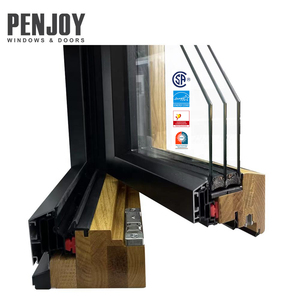
Thermal bridge elimination is achieved through multi-chambered 24mm to 35mm Technoform PA66 GF25 (polyamide reinforced with 25% fiberglass) thermal barrier strips. This structural configuration isolates exterior temperatures, reducing conductive heat transfer to realize U-factors below 1.4 W/m²K (U ≤ 0.25 BTU/hr·ft²·°F), qualifying installations for Passive House and LEED Platinum benchmarks across North America and Australasia.
Precision Surface Finishing (Qualicoat Class 2)
To resist coastal salt-mist oxidization and heavy UV degradation, premier exporters deploy vertical powder coating lines utilizing AkzoNobel or PPG fluoropolymer (PVDF) formulations. Achieving film thicknesses exceeding 60-80 microns ensures zero chalking or peeling under ASTM D2244 weathering tests, exceeding AAMA 2604 and AAMA 2605 high-performance specifications.
| Engineering Metric | Standard Commercial Casement | DERCHI Export-Grade Thermal Casement | Passive House Alu-Wood Specification |
|---|---|---|---|
| Alloy & Temper | Commercial 6063-T5 (1.4mm profile) | Architectural 6063-T6 (1.8mm – 2.2mm) | Composite 6063-T6 + Solid Oak / Larch |
| Thermal Insulation (U-Factor) | 2.8 – 3.2 W/m²K (Conductive) | 1.3 – 1.6 W/m²K (Multi-Cavity PA66) | ≤ 0.8 W/m²K (Triple Glazed Argon Warm Edge) |
| Air Infiltration Rate (ASTM E283) | ≤ 0.30 cfm/ft² | ≤ 0.05 cfm/ft² (Double EPDM Compression) | ≤ 0.01 cfm/ft² (Triple Continuous Vulcanized Gasket) |
| Water Penetration Resistance (ASTM E331) | 300 Pa (Static Pressure) | 700 – 900 Pa (Integrated Weep Baffles) | 1050 Pa (Hurricane/Cyclone Structural Barrier) |
| Acoustic Attenuation (STC / OITC) | STC 28 – 31 dB | STC 38 – 42 dB (Acoustic PVB Lamination) | STC 44 – 48 dB (Decoupled Soundproof Glazing) |
| Hardware Cycle Life (AAMA 901) | 10,000 Cycles | 25,000+ Cycles (Siegenia / Sobinco Multi-Point) | 50,000+ Cycles (Heavy Duty Concealed Hinge) |
Future Procurement Trends in Aluminium Windows (2025–2030)
A strategic overview of emerging manufacturing protocols, decarbonization directives, and logistical parameters transforming international facade procurement.
1. Embodied Carbon & Low-Carbon Aluminum
With North America's Buy Clean policies and Europe's CBAM (Carbon Border Adjustment Mechanism), institutional specifiers now demand Environmental Product Declarations (EPDs). Leading Chinese exporters have begun utilizing hydroelectricity-smelted low-carbon primary aluminum billets, slashing cradle-to-gate carbon footprints from 16kg CO₂e/kg to under 4kg CO₂e/kg aluminum.
2. BIM-Integrated DFM (Design for Manufacturing)
Traditional procurement cycles characterized by 2D shop drawing revisions are being phased out. Direct factory partnerships now integrate Revit and IFC BIM files straight into 5-axis CNC machining centers. This automated file-to-factory workflow eliminates human transcription errors in hardware notch routing, thermal strip insertion, and screw-hole anchoring down to ±0.2mm tolerances.
3. Ultra-Narrow Sightlines & Concealed Hardware
Architectural demand is gravitating toward invisible frames that amplify the visible glass-to-frame ratio. Next-generation casement assemblies integrate flush outward sash profiles, zero-sightline mullions, and completely concealed 180-degree friction stays. This delivers a uniform curtain-wall aesthetic while maintaining structural load capacities against heavy cyclic wind pressures.
Guangdong Dejiyoupin Doors & Windows Co., Ltd. (DERCHI)
A Top 10 Chinese Door & Window Brand with 25+ Years of Dedicated Fenestration Engineering Excellence.
180,000m²
Modern Production Base
600+
Skilled Craftsmen & Engineers
100+
Patents & Global Certifications
25+
Years Manufacturing History
One-Stop Sourcing
Consolidate your entire fenestration package directly with our Foshan factory: aluminum casement windows, architectural pivot doors, bi-folding patio systems, cast aluminum security entry doors, and automated garage assemblies.
Free CAD Shop Drawings
Provide rough opening dimensions in imperial or metric. Our in-house engineering team returns certified CAD elevations, anchor connection details, and structural thermal calculations tailored specifically to your project schedule.
AS 2047 N6 & CE Certified
Proven durability in cyclonic coastal wind zones. Our window and door profiles pass AS 2047 cyclonic level N6 testing, AS1288 glazing requirements, CE safety norms, and UL fire classifications with comprehensive third-party lab documentation.
EST/PST Engineering Support
Direct communication with fluent, English-speaking fenestration engineers during North American business hours. Avoid costly import errors with real-time review of hardware selections, sub-sill extrusions, and flashing details.
Procurement & Technical FAQ for International Importers
Actionable answers addressing code compliance, ocean packaging integrity, thermal modeling, and direct factory procurement logistics.
Q1. How do you ensure casement window profiles meet US/Canadian/Australian local building codes?
Our products are engineered strictly to AS 2047, NFRC thermal standards, and CSA A440 fenestration performance guidelines. Every export order undergoes full CAD shop drawing verification with our registered facade engineers. We supply structural calculation sheets verifying positive/negative wind loads, water penetration ratings, and IGCC/SGCC safety glass stamps directly on the spacer bars.
Q2. What prevents damage and optical scratches during trans-oceanic container transit?
Export packaging complies with ISPM-15 fumigation standards. Each casement sash is wrapped in low-density polyethylene film, protected with rigid corner bumpers, separated by high-density EVA foam pads, and encased in custom solid-plywood crates. Crates feature integrated bottom forklift skids and moisture-absorbing silica gel packs inside container sea-lines.
Q3. How do your thermal break casement windows compare to European brands like Schüco?
British, Australian, and American builders frequently choose DERCHI as a direct value-engineered alternative to German brands. We employ the same precision European hardware partners (such as Siegenia, GU, Sobinco) and genuine Technoform PA66 thermal barriers. Our testing confirms identical water tightness (up to 900 Pa) and acoustic attenuation at roughly 40-55% reduced direct-to-site costs.
Q4. What is the factory lead time and project procurement schedule from Foshan?
Standard custom architectural orders require 25 to 35 business days following final CAD drawing approval and glass cut sheet confirmation. High-volume commercial contracts or multi-unit custom color finishes (custom RAL powder coating or woodgrain sublimation) are scheduled in rolling batch containers to match on-site installation sequences.
Q5. What hardware configurations are offered for extreme weather and high wind pressures?
We configure 304/316 marine-grade stainless steel multi-point locking gear, heavy-duty load-bearing friction hinges capable of carrying up to 180kg sash weights, and reinforced multi-cam shoot bolts. For cyclone/hurricane applications, outward-opening projecting sashes incorporate impact-resistant SGP laminated safety glass packages.
Q6. Can your technical team customize profiles for existing rough opening renovations?
Yes. We offer custom nail-fin flanges (1-inch or 1.5-inch setbacks) for North American wood-stud framing, masonry sub-frames, sub-sill weep tracks, and flush flangeless profiles designed for direct receptor-and-subhead commercial installations, ensuring airtight weather-tight integration with your building envelope.