Engineered Fenestration & Oversized Pivot Systems
Explore our export-certified architectural product line, rigorously built to North American AAMA/WDMA standards, NFRC thermal metrics, and international cyclone wind load codes.
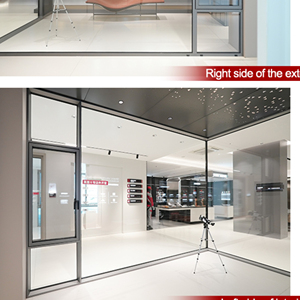
Customized Aluminium Thermal Break Double Glazing Window
- Insulation: Multi-cavity polyamide PA66 strip
- Glazing: Dual tempered Argon-filled IGUs
- Hardware: German concealed multi-point lock
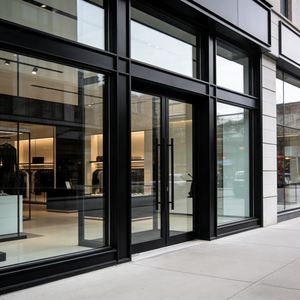
Soundproof Waterproof Aluminum Glass Commercial Swing Door
- Rating: NFRC certified sound & water seal
- Profile: 6063-T6 heavy architectural gauge
- Application: Storefronts, restaurants & retail
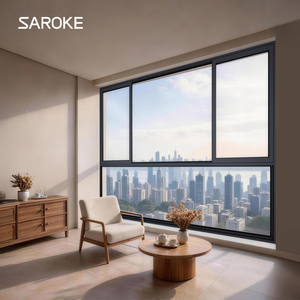
Hurricane Impact Resistant Double Glazed Aluminium Sliding Window
- Glass: SentryGlas® / PVB laminated glass
- Design: High static wind load deflection resistance
- Weathering: EPDM marine continuous dual gaskets
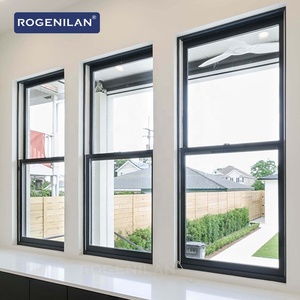
American Waterproof Aluminium Double Hung Vertical Sliding Window
- Balance: Heavy-duty spiral or block-and-tackle
- Operation: Smooth vertical tilt-in sash clean
- Finish: AAMA 2605 fluoropolymer PVDF coating
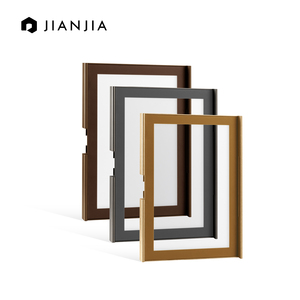
Minimalist Narrow Stile Aluminum Glass Interior System
- Frame: Ultra-slim 16mm architectural sightline
- Glass: Fluted / tinted / low-iron safety panels
- Track: Concealed dampening soft-close mechanism
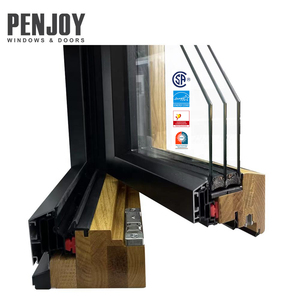
Penjoy Alu-Wood Triple Glazed Passive House System
- Thermal: Ultra-low U-factor < 0.8 W/(m²·K)
- Wood: FSC certified laminated oak / pine core
- Exterior: Weather-defending seamless alu cladding
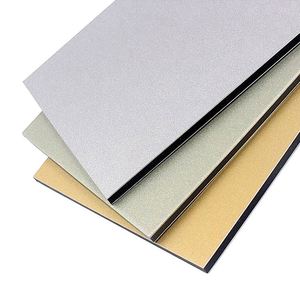
Heavy Architectural ACM Composite Panel Exterior Door
- Core: Mineral fire-retardant structural matrix
- Surface: Anodized / woodgrain textured laminate
- Performance: Zero warp in high solar radiation zones
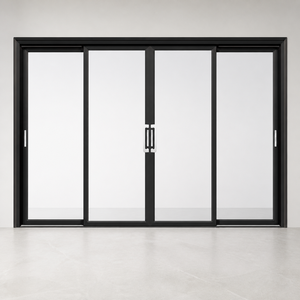
Heavy Duty Aluminum Sliding Patio Door Double Glazing
- Configuration: Multi-track pocket & bypass leaves
- Rollers: Heavy stainless steel precision quad tandem
- Threshold: Flush ADA-compliant barrier-free water track
Structural Mechanics & Physics of Oversized Aluminium Pivot Systems
Modern luxury architecture demands ever-expanding entrance portals, frequently exceeding 2.2 meters in width and 4.5 meters in height. At this monumental scale, traditional side-hung butt hinges fail catastrophically due to cantilever moment forces, torsional deflection of vertical jambs, and accelerated fatigue of fixing fasteners. Custom OEM aluminium pivot doors represent a radical departure in mechanical load path management: by repositioning the operational axis 150mm to 400mm inside the leaf's perimeter, the dead load (often ranging from 350 kg to over 1,200 kg) is transferred directly downwards into the structural subfloor through a hardened pivot spindle, eliminating tensile pull on the top head jamb.
As a specialized OEM/ODM manufacturer, Guangdong Dejiyoupin Doors and Windows Co., Ltd. (DERCHI) engineers our pivot assemblies from aviation-grade 6063-T6 and 6061-T6 extruded aluminium alloys. Wall thicknesses across our structural core stiles are calibrated between 3.0mm and 4.5mm, incorporating internal longitudinal reinforcing webbing. This high moment of inertia resists localized buckling under severe positive and negative cyclical wind pressures. To address the inherent thermal vulnerability of metal frameworks in extreme North American climates (Zone 4 through Zone 7), our systems integrate structural polyamide (PA66 GF25) thermal breaks reinforced with 25% glass fiber. This delivers a continuous thermal barrier that minimizes U-factors down to 0.18–0.24 BTU/(hr·ft²·°F) while entirely preventing interior dewpoint condensation during sub-zero Canadian winters.
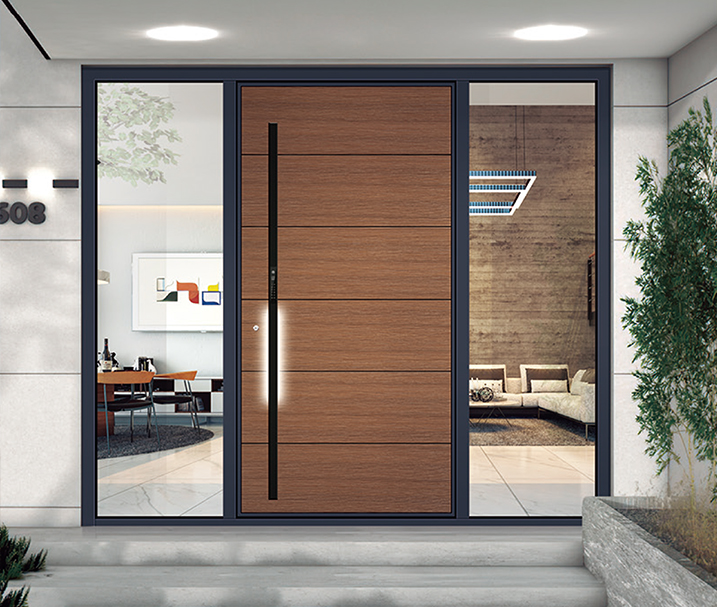

Engineering Matrix: Pivot Door Configuration vs. Project Typology
Compare baseline engineering parameters to match the right door profile, glazing architecture, and security protocols to your local building codes.
| System Typology | Structural Profile Gauge | Max Leaf Dimensions (W × H) | Thermal Metric (U-Factor) | Air & Water Infiltration Test | Acoustic Rating (STC) | Recommended Specification |
|---|---|---|---|---|---|---|
| Thermally Broken Pivot | 3.2mm 6063-T6 / PA66 GF25 | 2,400mm × 4,500mm | 0.19 – 0.23 BTU/(hr·ft²·°F) | ASTM E283 / E331 > 600 Pa | STC 42 – 46 dB | Luxury Residential / Cold Zones |
| Cast Aluminum Art Pivot | 3.5mm Base + 8–12mm Relief | 2,200mm × 3,800mm | 0.24 – 0.28 BTU/(hr·ft²·°F) | AAMA/WDMA Class CW-PG50 | STC 40 – 44 dB | Prestige Estates / Coastal Luxury |
| Full-Glass Vision Pivot | 3.0mm Slim Stile / Double IGU | 2,000mm × 4,000mm | 0.22 – 0.26 BTU/(hr·ft²·°F) | ASTM E330 Cyclone 5,500 Pa | STC 38 – 42 dB | Modernist Villas / Storefronts |
| High-Security Steel/Alu Armor | 4.0mm Extruded Alu + 304 SS Plate | 2,500mm × 5,000mm | 0.21 – 0.25 BTU/(hr·ft²·°F) | UL 10C / EN 1627 RC4 Fire-Rated | STC 45 – 49 dB | Commercial HQ / Diplomatic Assets |
Global Sourcing Dynamics & Future Engineering Procurement Trends
The international fenestration and entrance market is experiencing a profound tectonic shift driven by two converging vectors: hyper-minimalist design doctrines and stringent municipal energy conservation codes (such as California Title 24, IECC 2024, and the Canadian National Building Code Tiered Energy Framework). Sourcing professionals, facade engineers, and general contractors who previously settled for off-the-shelf distributor inventories are aggressively turning to direct OEM/ODM custom manufacturing partnerships. The historical barrier—fear of lead time delay or specification discrepancy—has been obliterated by digital manufacturing integration, 3D laser-scanning rough-opening validation, and seamless BIM/Revit workflows.
Key procurement trends emerging across luxury commercial and custom residential markets include:
Drop-Seal Pneumatic Gasketing
Traditional pivot doors suffered from air leakages at the top and bottom pivot clearances. Forward-looking specifications demand concealed, mechanically triggered drop seals and magnetic perimeter air barriers that automatically engage when the leaf closes, achieving near-zero air infiltration.
Motorized Biometric Smart Access
Integration of concealed concealed motor drives, facial recognition cameras, motorized multi-point mechanical latches (such as Fuhr or Winkhaus systems), and smart home automation integration via secure BACnet or KNX protocol relays without visible conduits.
Low-Embodied Carbon Sourcing
Developers are specifying aluminum billet refined through hydroelectric energy rather than coal-fired smelting, backed by Environmental Product Declarations (EPDs) to earn valuable LEED v4.1 Platinum and BREEAM building credentials.
By leveraging Guangdong Dejiyoupin's factory direct OEM channel, North American general contractors bypass domestic middleman markups (frequently exceeding 150–220%), securing custom engineered, heavy-duty entrances fabricated precisely to jobsite rough openings with pre-assembled subframes ready for rapid anchorage.
Why World-Class Developers Partner with DERCHI
Headquartered in Foshan, Guangdong—the silicon valley of architectural aluminium extrusion—our enterprise unites heavy industrial capacity with bespoke European artisanal detailing.
180,000 m² Mega Campus
Vertical industrial integration encompassing CNC profile cutting, automatic thermal insertion, TIG precision welding, robotic coating, and structural silicon curing chambers under one roof.
Certified Code Compliance
Products hold validated CE, ISO 9001, Australian AS 2047 N6 (cyclone grade), and UL 10C positive pressure fire-rated certifications. Full engineering compliance submittals furnished for city plan checks.
Free BIM & CAD Shop Drawings
Our dedicated bilingual engineering team provides complete submittal packages within 48–72 hours, including head, jamb, threshold anchor detailing, glass stress analysis, and wiring schematics.
EST–PST Real-Time Alignment
Direct communication during North American working hours. Dedicated project managers handle your order from architectural concept through ocean freight customs clearance to the final jobsite hoist.
Global Testing Compliance & Accredited Laboratory Certifications

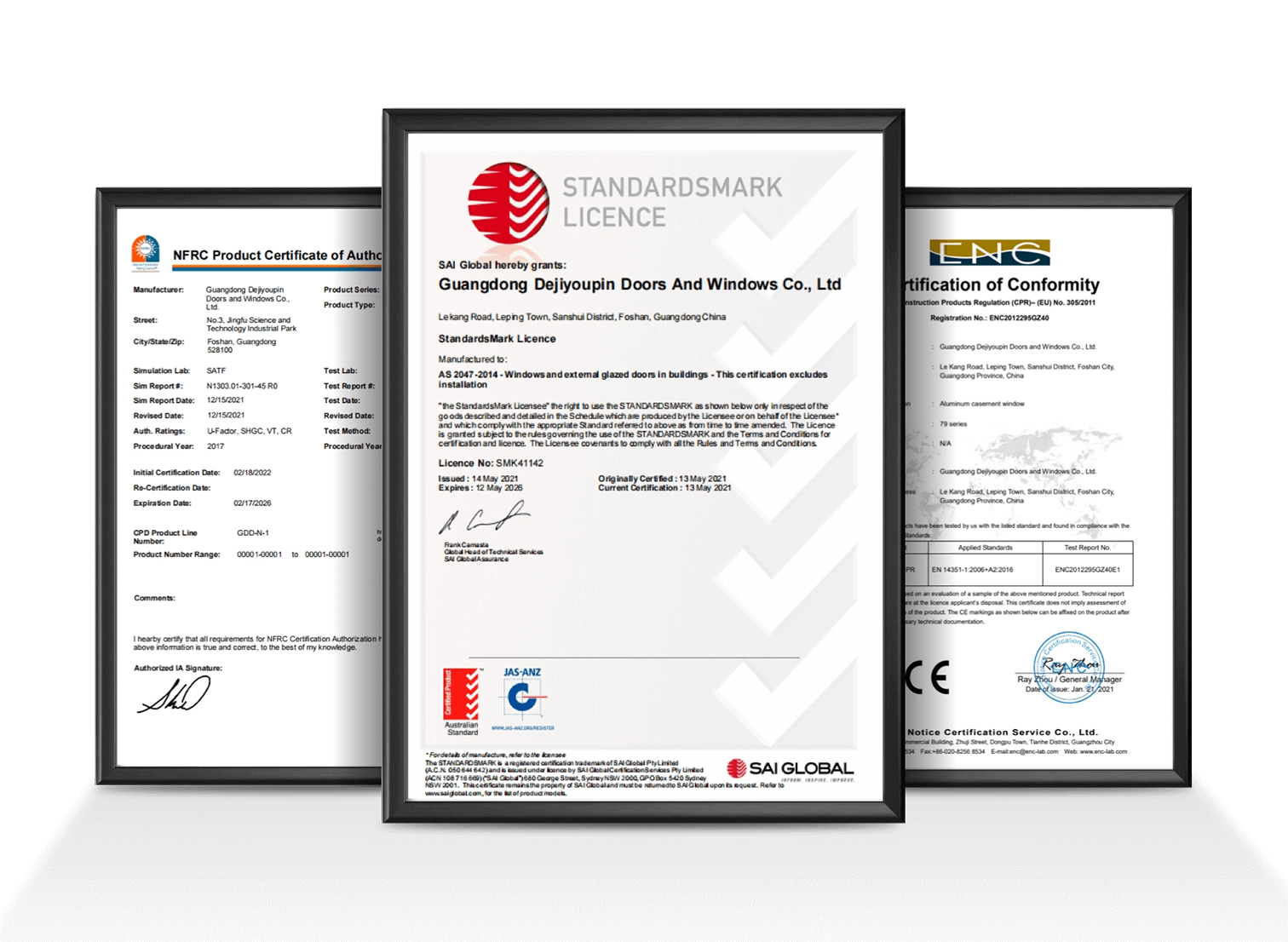
Tested in accordance with ASTM E330, AAMA/WDMA/CSA 101/I.S.2/A440-11, AS 2047, and ISO 9001:2015. Certified test reports are furnished with project shop drawing submittals.
Zero-Defect Export Crating & Jobsite Installation Workflow
The greatest architectural entrance door is only as good as its arrival condition. Oversized aluminum pivot doors, often weighing up to three-quarters of a metric ton with triple-glazed units installed, face severe acceleration, shear stresses, and humidity swings during transatlantic and transpacific containerized ocean transit. DERCHI has developed an industrial crating protocol specifically calibrated for export to North America, Europe, and Australasia.
1. Pre-Assembly & Laser Alignment
100% of pivot door leaves and frame sub-assemblies are test-hung on factory test rigs. Hydraulic closing speeds, zero-gap perimeter latching, and smart locks are fully cycled and recorded on high-definition video before dismounting.
2. Multi-Layer Protective Envelope
Profiles are wrapped in 80-micron static surface preservation film, encased in shock-absorbing high-density polyethylene foam edge bumpers, vacuum-sealed with moisture desiccant bags, and strapped within rigid corner steel braces.
3. Fumigated Solid Plywood Crating
Every unit is encased in ISPM-15 compliant fumigated structural plywood crates with built-in forklift pockets and internal shock-watch impact indicators. Designed to withstand multi-tier container stacking and rough jobsite handling.
Frequently Asked Questions: Technical & Commercial FAQ
Direct, unvarnished engineering answers addressing structural integrity, windload calculations, import tariffs, and on-site alignment for architects, estimators, and builders.
How do oversized aluminium pivot doors achieve proper water and air tightness?
1. Concealed Mechanical Drop Seals: Spring-loaded, air-cushioned Santoprene drop seals embedded flush within the top and bottom stiles trigger automatically as the door engages the final 5° of closing travel.
2. Thermally Broken Threshold Profiles: We utilize low-profile, ADA-compliant architectural sill plates featuring integrated weeping channels and internal silicone check-valves that prevent wind-driven rainwater backflow under static pressures up to 600 Pa (ASTM E331).
3. Magnetic Dual EPDM Fin Gaskets: Continuous co-extruded magnetic perimeter weather-stripping provides continuous seal contact along the vertical jambs, drastically curbing air permeability to under 0.1 CFM/sq.ft.
Can custom pivot systems withstand severe hurricane-zone wind loads (Miami-Dade / Florida Building Code)?
What is the required floor substrate condition to anchor heavy-duty pivot hardware?
What are the lead times for custom OEM/ODM pivot door production and ocean logistics?
How does DERCHI's quality and pricing compare to European manufacturers like Schüco or Reynaers?
What warranty and post-sale installation support does DERCHI provide overseas buyers?
Initiate Your Custom OEM Pivot Door Engineering Quote
Send our senior engineering department your architectural plans, rough-opening dimensions, or door schedule. We will deliver full structural consultation, thermal calculations, and CAD shop drawings within 48 hours.